Monday, 2 May 2011

Which drawing is the correct drawing?

With the lower ribs all complete, and the basic spars completed, but not cut to length, it was time to do an initial assembly of the lower wings, to work out where the fittings would go, as well the drag / anti drag wires, and the general assembly.
Right Hand lower wing trail assembly
While this was a very encouraging photo, it would be another 6 months before this wing would be glued together! If someone had told me that when I did this trail assembly in October 2010, I would never have believed them.
next step was to work out where the ribs would go, and mark for the various fittings, plywood doublers, wires, and hardware.

and this is when I found out nothing really measured up...

I had been using a general arrangement drawing apparently based on the EAA replica wings, and approved by Matty Laird back in the late 70`s.

Unfortunately on examination, the rib spacing dimensions on this drawing did not match either the EAA rib spacing as measured on the airplane, or the Rib spacing on the Paul Matt drawings, (previously assumed to be the most accurate of the Super Solution drawings)
so which one was correct?
Well, I decided that as the EAA drawings had more details than any other, they would be the "correct" drawings, but the various reference differences were quite significant
I have also found each potential change has a snowball effect, and predicting just how much it changes the follow on process is not very easy.
Well, with a rib spacing determined, and the general assembly worked out, it was time to take the ribs back off, and start on the fittings, and doublers.

Starting with the easy parts

I spent the Spring, and Summer of 2010 collecting the raw materials required, spar grade Sitka Spruce, mahogany aircraft plywood, 4130 steel tubing, as well as various hardware, and components.

By late July I had the materials ready to begin the lower wings, as well as the required tools, incuding a new table saw, planer, sanders, bandsaw, drill press, router, and bench grinder all on hand.
I had also built the benches and tool stands.

By August I had run out of excuses.

I started the lower wing ribs August 25, 2010, and made good progress for a week, until I realised I was building them completely incorrectly.

Great, so that was a waste of a week, 2 sheets of really expensive plywood, multiple now useless fixtures and lots of spruce. 

Nice start.

I then worked out the correct rib construction method by re-studying photos of the EAA replica ribs, but it was an expensive lesson to thoroughly study every detail before cutting wood. 
EAA lower wing ribs, also showing a solid spruce
compression rib
New correct lower wing ribs
Then I realised just how hard the actual ribs were to build! I can only assume that E.M. Matty Laird had lots of very dedicated and inexpensive employees making what are the most time intensive ribs I have ever seen.
Each rib requires an inner spine of 1/16th mahogany plywood, which is routed in a three step process. Each process requires a separate router fixture. Pre-shaped upper and lower spruce capstrip, both also slotted to take the plywood spine, each inner spruce capstrip must be pre cut to length and angles, then notched to slot over the plywood spine, and all is then assembled in two special assembly fixtures.
No nails are used in the rib construction, only epoxy, and I reached a point where I could build 2 ribs per day, one to the finished assembled point, and one to the first fixture point. There are 28 ribs in the lower wings, some truss, some compression, and some with different spar slot widths.
Slotted spruce capstrip 
Fixture to pre-bend capstrip leading edges
The lower wing ribs were completed by October 2010, they were quite a steep learning curve, as they taught me the value of checking details again and again befiore commiting to the parts.
I realised I was not building another Pitts, and this would be a very different experience to my previous building projects.

An exact replica???

Not as easy as the title suggests,
this has been an argument since the first Tower of London Axe was replicated.


Sorry "restored".
A small issue is the restored axe has had 5 new heads, and 9 new handles, but it is still the original Tower of London Axe, right?
An 80 year old airplane, be it restoration, reproduction, or replica, is not going to be as it was the day it left the factory. It cannot be, as methods and materials have changed, so while it can be pretty close, if the intent is an airworthy aircraft, it must be built to operate in a world of Aviation which has moved on 80 years as well.

Back in 1931 the crosswind had yet to be invented. The first crosswind coincided by cooincidence with the invention of the first directional runway, but in 1931 airports were still mostly square fields, so landing into wind was standard practice, and the runway surface was grass, bumpy and sometimes pretty short.
All of the above lent itself well to tailskids, and three point landings.
In our modern aviation world, crosswinds are well and truly a regular occurence, paved runways make a tailskid the equivelant of an ice skate, and try landing your skid equipped aircraft on a grass strip... you will be asked to replace your 200 yard divot.
So, what can we conclude from the above? well we are not going to be able to build an exact replica, no matter how pure our intentions, and we will have to consider the environment we hope to operate the aircraft in, and build it accordingly.

The original Laird Super Solution had a tailskid, poor brakes, no radio, an extremely early version of the P&W wasp Jr engine, a non sensitive altimeter, linen fabric, no means of inspection, a mixed material wire braced fuselage construction, and who knows what type of assembly glue.
So, there will some minor changes in the interest of aircraft and pilot longevity, the replica will have a tailwheel, hydraulic brakes, a small portable radio and transponder (hidden if possible) a more modern and therefore more reliable R985 engine, dacron fabric, nutplates and inspection panels where appropriate, an all 4130 steel non wire braced welded fuselage, and all wings assembled with epoxy glue.
(I am still searching for a non sensitive altimeter)

The items which will not change include the original airfoil, or relative chord (M12) the overall dimensions, the propeller, the wing rib and wing construction method, the ailerons, fuel and oil tanks, tail construction, trim, controls, the colour scheme, and the balance of the instruments.

I shall also add a couple features not found on the original in any form, an extra set of crossed wires between the gear legs, as without them the full landing and flight loads are transfered to the wing spars.
Engine to cowl isolation mounts, as the original had none, and I can only imagine the vibration, not to mention the inevitable cracking of components.

So, while I intend to replicate the Laird Super Solution as faithfully as possible, and the final result should look exactly like the original internally and externally, there will be a certain number of small concessions to the modern world of safety, and operation.

None of the changes will in any way take away from the aircraft visually, nor will they change the flight characteristics one bit. The Super Solution of today will fly exactly as the Super Solution of 1931, and is that not the best possible result for a modern replica?

Sunday, 1 May 2011

Nobody builds an airplane alone

Well, that may not be exactly correct, but for the most part, it would be pretty hard to lock yourself away in your garage, and emerge weeks, months, years, (more probably) decades with the finished product.
When it is a replica of an aircraft built over 80 years ago, it would be almost impossible without help.
I was lucky enough during my search for documentation, to be connected with some highly experienced experts on the aircraft and the Golden Age in general.
Ed Escallon, Ed managed the original Florida and EAA replica project, and took it from a basic collection of parts up to the completed aircraft now displayed in the EAA museum.
Ed in front of the EAA replica, holding a "new" Super Solution lower wing rib
Ed is a walking encylopedia of the Golden age racing era, and in particular the Super Solution. he has met and corresponded with almost every designer and pilot of the Era, most of who are no longer with us. Ed has been an incredible resource, supplying details such as drawings, photos, expertise, and even coming on road trips with me to examine the EAA version in the museum.  In the process, Ed has become a friend and advisor. His enthusiasm even after 30+ years of involvement in the Super Solution is amazing. This project could not have gotten off the ground without Ed`s help and encouragement.

Jim Moss has also been a great resource, with photos and documents, as well as some really good insight into flying the Super Solution. As Jim is the only pilot alive, who has flown a Super Solution in the last 80 years, he is a rather unique fellow to speak with. Jim and his wife Judy, have been very accomodating  hosts for my visits, and I look forward to the trips.
Jim and Judy, with their Super Solution
Not resting on his accomplishments, Jim has been hard at work on an incredible new Golden Age replica, the Gee Bee QED, which he hopes to have flying by the end of 2011. It is a stunning project.
The Jim Moss QED, a stunning project!
Tom Jensen who did all of the welding on the Moss Super Solution replica, and is also a retired Boeing 777 engineer. Tom is able to advise on both the original construction methods as well as safe current practice, bridging 80 years of aircraft design and development. Tom has been a wonderful source of documentation and advice, he is also a heck of a good welder!

Tom Poberezny, EAA Chairman of the Board, Alan Westby, EAA Airventure Museum Director, Baulken Noack, Director of Museum exibits, and the rest of the EAA museum staff. Tom, Alan and Baulken were kind enough to allow me to measure, photograph, and make templates of the Museum replica over a number of days. They are enthusiasts first and foremost, and they prove that the EAA is unique in Aviation, as it is still all about the members. They are a great source of advice and encouragment.

Kermit Weeks, founder of the Weeks Fantasy of Flight Air Museum, and current owner of the Moss Super Solution. Kermit has been very kind with access to the documentation held in the museum, as well as offering some great advice.
Kermit is unique in that he could hold a Thompson Trophy race by himself with the various Golden Age racers he owns, a true Golden Age enthusiast, Kermit is a great source of encouragement.
(If you need a volunteer to fly in the Thomson recreation Kermit, I am not fussy, Super Solution, Gee Bee R2, Z, ) :)

I am not quite sure how David Oviatt became involved with this project, but the poor fellow through no real choice of his own, has become the project "computer guy" and is now constantly in demand to produce more drawings and dimensions. David has an amazing ability to create an exact 3D CAD drawing, using only low quality photos and my crude pencil sketches. 
Super Solution aileron hinge
He is also building a unique racing aircraft of his own, a Knight Twister COED, of which none currently exist.

Larry Harmacinski who is an expert Waco pilot and restorer, has also been a secret Super Solution racer enthusiast for many many years. Larry knows everyone in the Antique aircraft world, and has been an invaluable source of advice and contacts. he is the go to guy for just about any hard to find part and service,

My 7 year old Daughter, Jamie, who is my constant companion in the shop, she is an expert tool collecter, and holder, as well as a whiz with a micrometer. She loves woodwork, and knows more about racing biplanes than any other 7 year old girl I know. She enjoys the wing building process, although she does keep a Nintendo DS handy for the more boring bits!
Jamie working on the wingtip bows
note the steel toe fuzzy bunny slippers
There are so many other people who have either directly or offered help on this project, so I shall try to include them as we go along. One of the real benefits of building a Golden Age racer replica is all the great people you meet in the process. There is so much enthusiasm for this project, and a genuine passion still exhibited for the racers of the 30`s. It fun to be working on the airplane.

The Super Solution, features and details

The original Super Solution was built by 15 men in about 45 days, and was completed in August 1931.
They slept in bunks at the factory, and did not take too many coffee breaks.
(It took me longer to build just the lower wing rib jigs, so it does not look like I will match their building results)
The aircraft had a steel tube and aluminum fuselage, welded steel gear legs, welded steel tail surfaces, and wooden wings The wings, tail and rear fuselage were fabric covered, and sheeted in aluminum from the seat forward. The engine was a very early direct drive Pratt and Whitney R985 "Yellow Jacket" wasp JR radial engine.

The propeller was a Hamilton Standard ground adjustable 9 foot unit.
The engine produced around 450 HP but they turned them high enough to get upwards of 510 Hp from the engine.
(Not a good idea these days)
The reason for the mixed fuselage construction was initially thought to be weight, but the real reason was almost certainly the lack of suitable thin wall welding expertise in the day.
Overall the aircraft was quite simply built, with small overall dimensions.
The wingspan was 21' feet, it was 17.9" long, and it had an all up weight of 2675 pounds.
The original had a tailskid, and marginal brakes, which were acceptable for the airfields of the day, but would no longer be suitable.
The aircraft was fit with basic instruments, no radios, and minimal navigation equipment, (a compass) yet Jimmy Doolittle was able to navigate the aircraft in record times across the United States, up to Canada, and down to Mexico, an incredible acheivement.

So, why a Super Solution??

fair question.

I have had a real passion for Biplanes since I could recognise one, something about the bridge like structure, the obvious strength, the evocative look, the romance, the small dimensions, all of which make them incredibly attractive to me.
I was drawn to the Pitts designs at an early age, and I have always loved the look, sounds and performance of radial engines, so the most attractive Pitts was always Samson, a one off airshow design by Curtis Pitts back in the late 50`s, and first replicated by Steve Wolf in the mid 80`s, and then recreated a number of times by various builders.
Of the various Samson replica`s built I think this was the most beautiful, built by Barry Manktelow, for Pip Boorman.
This was the one for me, but at 19 years  of age, it seemed a bit more than I could imagine building, so instead, I built a single seat Pitts. Then I got a Christen Eagle II, then built another Pitts S1S.
But I always wanted a Samson.
Over the years I collected everything on Samson, I started a fuselage, and a complete set of wing ribs. I also realised that the airplane had some limitations, and there were certain things I wanted to change.
But the main negative for me was that it was not a real racing aircraft, it just looked like one.
Everytime I thought of the ultimate racing biplane, I kept coming back to the Laird Super Solution, and eventually there really was no other choice.
To me, there is no bad angle to the Super Solution, it looks fantastic from any view. From the front it has a Bulldog like appearance, all engine and gear, the wings are short, but still in proportion, the fuselage tapers drastically, yet the tail still looks great, from the side it looks like it is going 200 miles an hour, and from the back it looks powerful. In my opinion there is not a bad line on the aircraft.
(Would anyone be interested in a set of really nice Samson ribs?)

The Super Solution Replica`s

As I began the process of collecting drawings, as well as photos, documents, and dimensions, I also began to meet and hear of people involved in previous Super Solution projects.
I was aware that the EAA (Experimental Aircraft Association) had completed a replica of the Super Solution in the early 1980`s, from a project started by the Florida Antique aircraft association in the mid 70`s.
Florida Antique Aircraft Association/ EAA replica under construction
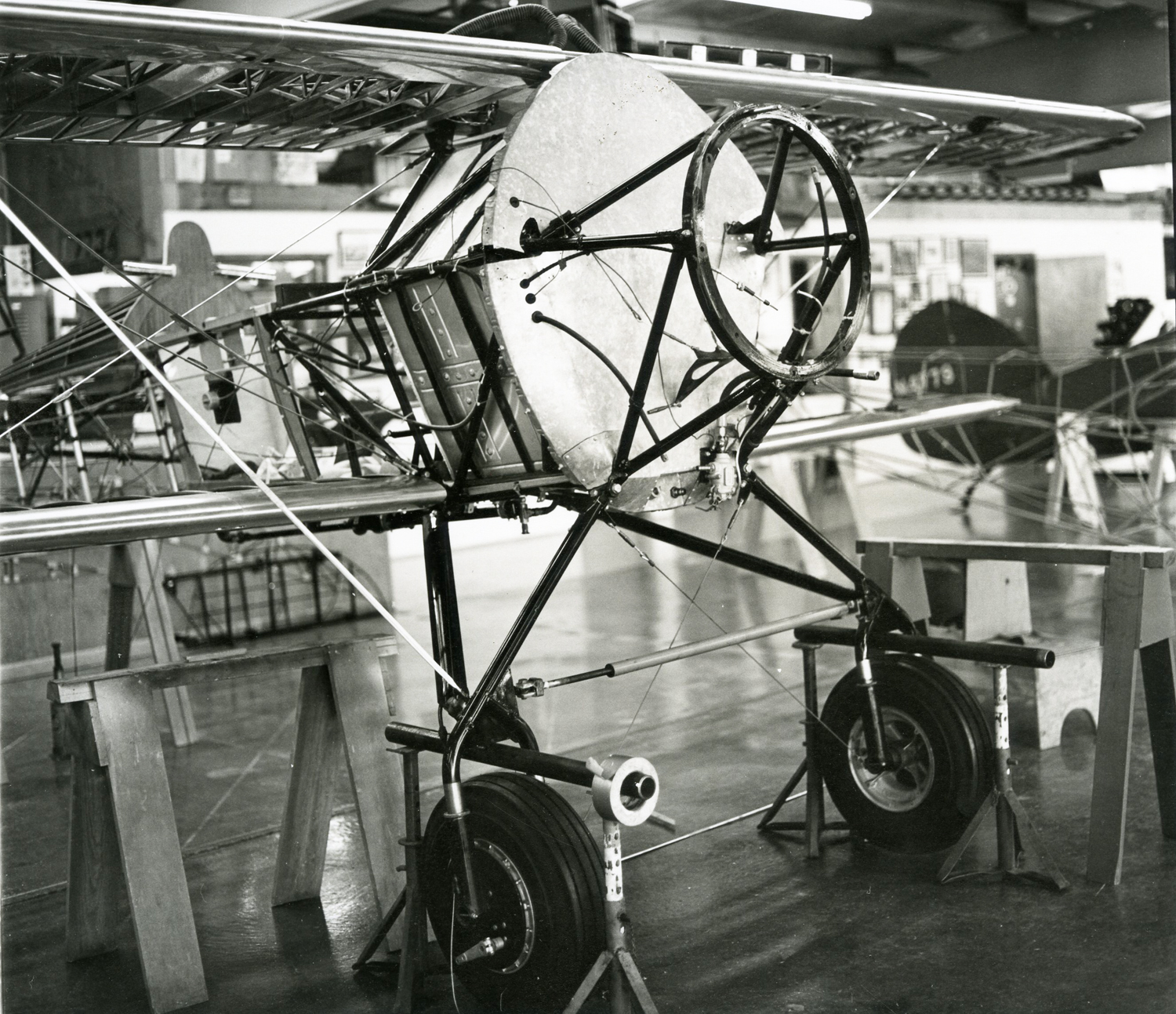
The EAA replica was completed to a high level of accuracy, and built to an airworthy standard, owing to the input and cooperation of the original designer, E.M. Matty Laird, and the pilot, General James Doolittle, but the decision was taken to place the aircraft directly on display in the museum, and not fly it.
The EAA museum replica, mounted in a dramatic air racing pose, but forever grounded
10 years later, Jim Moss, a prolific builder of Golden Age style biplanes, as well as being a long time airshow and antique pilot, decided it was time a Super Solution once again flew, and along with a dedicated group of friends he did just that.
Jim Moss Super Solution under construction
Jim and friends built the aircraft over a 4 year span, starting in 1996 and Jim made the first flight December 6, 2000. Jim then flew the aircraft to the annual Oshkosh Convention in 2002,
Jim Moss Super Solution on display at Oshkosh 2002
and soon afterwards the aircraft was sold to Kermit Weeks Fantasy of Flight museum, where it is displayed today.
The aircraft has not flown since arrival at the museum in 2002.
Jim Moss Super Solution on display in the Kermit Weeks Fantasy of Flight museum in Polk City, Florida
There are no other Super Solution projects underway, (that I know of)
There is no possibility of the EAA replica ever being flown, and it seems quite unlikely the Fantasy of Flight replica will fly again.
So, it is time another one had a chance to show just what an amazing aircraft the Super Solution was.

Early days

I started the Super Solution replica over a year ago now, about January 2010. Before any parts could be built, I needed to find out just what drawings and documentation existed.
The drawings search is an ongoing process, but to date I have managed to locate enough information to replicate the aircraft to a high level of originality.
The role of the Super Solution in Air Racing history has been extremely well documented, a very good summary can be found here:


Project Outline

I would like this to be an online record of my attempt to recreate an airworthy Laird LCDW 500 Super Solution.
The Super Solution was a racing biplane from the 1930`s, known as the "Golden Age" of air racing.